Born with Curiosity

The story of Grace Murray Hopper

Support the Film

Follow Along

Find out where we are in the process of making the film:

Production Blog

Grace Hopper: A Role Model for Girls in Tech!

“Our goal is to show the impact Grace had on the history of computer programming while also raising awareness of women’s contributions to the computer industry”, said Producer/Director/Screenwriter, Pierce

Short Bio

Grace Brewster Murray was born in 1906 into a privileged family in New York City. She received an exceptional education at private schools, including The Graham School and Miss Mary Schoonmaker’s School for Girls, where she developed her mathematical talents. Growing up in an affluent household that valued education, Grace was naturally curious – famously taking apart alarm clocks as a child to understand their inner workings. Her father worked in insurance and her mother loved mathematics, fostering an environment where Grace’s intellectual talents could flourish beyond the typical expectations for young women of her era.

Grace graduated from Vassar College in 1928 with a degree in mathematics and physics, later earning her PhD in mathematics from Yale in 1934 – one of the first women to achieve this distinction. She became a mathematics professor at Vassar, where she taught for 13 years. After the bombing of Pearl Harbor, Grace was determined to join the military despite being initially rejected for being too old at 36 and underweight. She persisted and eventually joined the Navy, where at age 37 she was assigned to work on the Mark I computer at Harvard’s Computation Laboratory under Howard Aiken. There, she wrote the first manual for a digital computer and began her pioneering work in programming.

In her later years, Grace became an influential advocate for computing, traveling extensively to give talks and popularizing concepts like the “nanosecond” using pieces of telephone wire to demonstrate how far information could travel in that time. Though she retired from the Navy multiple times, she kept returning to service, eventually attaining the rank of Rear Admiral. She maintained her characteristic sense of humor, keeping a clock that ran backward in her office and flying a Jolly Roger flag. Even into her seventies, she continued actively promoting computing technology and advocating that software should be free while users paid for support – an early precursor to modern open-source philosophy.

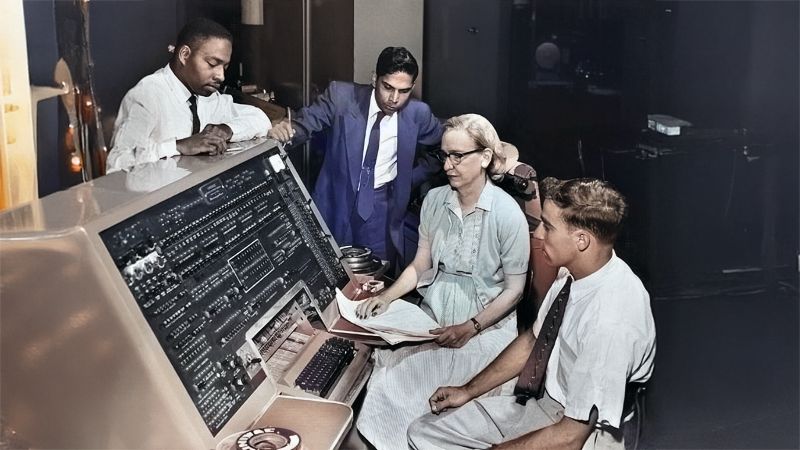
Grace Hopper revolutionized computing through numerous innovations, most notably creating the first compiler (the A-0 system), which translated mathematical notation into machine code. While she didn’t directly invent COBOL as often claimed, she developed its precursor, FLOW-MATIC, and was instrumental on the committee that created COBOL, earning her recognition as the “grandmother of COBOL.” Hopper popularized the term “debugging” after finding an actual moth causing problems in the Mark II computer. Her visionary insistence that computers could do more than mathematics changed the industry forever. For her contributions, she received numerous honors including a warship named after her (the USS Hopper), and posthumously, the Presidential Medal of Freedom in 2016. The annual Grace Hopper Celebration of Women in Computing commemorates her legacy as a pioneering woman in technology.

Subscribe to our Newsletter